
$5.5 Billion in 9 Months: Three Things the Climate Control Export Figures Tell Us
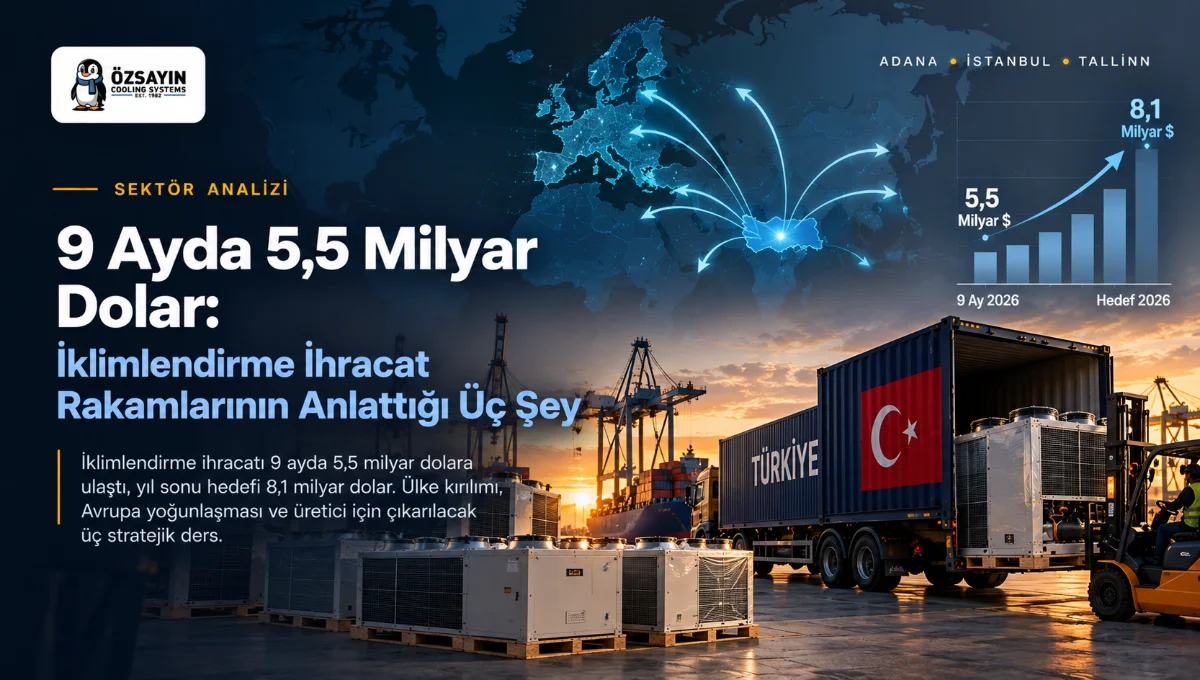
Osman Baştaş, Chairman of the Board of the Climate Control Industry Exporters' Association (İSİB), announced the figures for the first nine months of the year on 15 October 2026: sector exports reached $5.5 billion. In the same period, Türkiye's total exports rose 5.2% to $211 billion, and the climate control sector performed above that average. 2025 was a record year at $7.4 billion; the 2026 year-end target is $8.1 billion.
News like this is usually read for the size of the number and then passed over. Yet inside the breakdown there are three separate lessons for a company that manufactures in the sector or is considering entering export markets.
Breakdown of the figures
Top six markets by country (9 months)
| Country | Exports ($ million) |
|---|---|
| Germany | 635.1 |
| United Kingdom | 376.6 |
| Italy | 282.8 |
| France | 254.7 |
| Spain | 214.3 |
| Poland | 204.6 |
Fastest-growing markets (by value)
| Country | Increase ($ million) |
|---|---|
| Germany | +63.5 |
| France | +25.1 |
| Jordan | +19.4 |
| Egypt | +15.4 |
| Kyrgyzstan | +13.1 |
Production geography by province (9 months)
İstanbul $2.1 billion, Manisa $657.6 million, Bursa $480.1 million, İzmir $434.3 million, Kocaeli $375.9 million.
Lesson 1: The centre of gravity of exports lies in the F-Gas geography
All of the top six markets are in Europe. Germany alone is far ahead of the list at $635.1 million, and it is also the fastest-growing market (+$63.5 million). Once the United Kingdom is included, the picture becomes clear: Türkiye's climate control exports are heading to the region where the world's strictest fluorinated greenhouse gas legislation applies.
This is more than market information. It means that the EU's refrigerant timetable is the de facto regulation that shapes the product roadmap of the manufacturer in Türkiye. Equipment designed with a high-GWP refrigerant can sell without problems in the domestic market, while its market life is shortened in all six of these countries.
The practical conclusion: in product development decisions, the reference timetable should be that of the target market, not Turkish legislation. This applies not only to refrigerant selection but also to energy efficiency class, documentation language and certification scope.
Lesson 2: Growth is not coming only from Europe
The list of the five fastest-growing markets includes, alongside Germany and France, Jordan (+$19.4 million), Egypt (+$15.4 million) and Kyrgyzstan (+$13.1 million). The combined increase of these three countries is $47.9 million, equal to three-quarters of the increase achieved by Germany alone.
What this breakdown tells us is that risk is being diversified. Europe means high volume and high standards; the Middle East, North Africa and Central Asia offer a different equation:
- Faster decision processes and a lighter certification burden
- High outdoor temperatures — equipment needs to be validated at 45–50 °C design conditions
- Service network expectations — the widespread independent service infrastructure found in Europe is not at the same maturity in these markets, and after-sales support is at the centre of the purchasing decision
- Logistics advantage — transit time from Türkiye is markedly shorter than for Far East alternatives
Equipment designed to maintain performance at high ambient temperatures is an advantage that manufacturers in Türkiye naturally have thanks to their own climate. A unit validated in Adana and Mersin is already close to the technical specification of the Gulf and North African markets.
Lesson 3: Volume has grown, the real question is unit price
The question that export headlines leave in the shadows is this: how many kilograms does it take us to earn the same dollar?
Total value grows in two ways: by selling more products, or by getting a higher price for the same product. The commercial outcomes of the two are completely different. Exports that grow through volume are exposed to exchange rate and freight fluctuations; as margins thin, they leave no option other than increasing production capacity. Exports that grow through unit price are fed by the engineering, brand and service layers and are more resilient to currency movements.
The items that lift added value are generally grouped under the same headings in the sector:
- Including engineering services in the product: Capacity calculation, selection and commissioning support. Selling a solution rather than equipment makes price comparison harder.
- Remote monitoring and service contracts: The layer that turns a one-off sale into recurring revenue. It also makes the relationship with the customer lasting.
- Remanufacturing and overhaul capability: In a period when delivery times for new equipment are lengthening, refurbished equipment sells a time advantage, not a price advantage.
- Custom solution manufacturing: Process conditions that standard products do not meet — low temperature, high condenser water temperature, harsh environments — are areas where competition is thin.
What does the production geography say?
The distribution by province shows that the sector is concentrated along the Marmara and Aegean axis: İstanbul, Manisa, Bursa, İzmir and Kocaeli are in the top five. This concentration has an advantage — the supplier ecosystem and skilled labour are in the same geography. It also has a disadvantage: production capability in the Mediterranean and Southeast, despite their proximity to their natural export markets (the Middle East, North Africa), does not show up in the table.
For a company manufacturing in Adana, this is not a gap but a positioning opportunity: logistical proximity to the target market and a product validated at high ambient temperature are two advantages held at the same time.
Frequently asked questions
Which products are included in climate control exports?
Within the scope of İSİB, the climate control industry is a broad group covering refrigeration, air conditioning and ventilation equipment, as well as installation, insulation and related components. The $5.5 billion figure announced belongs to the sector as a whole; no sub-breakdown has been shared.
Is the year-end target realistic?
Going from $5.5 billion in nine months to $8.1 billion requires approximately $2.6 billion in the last quarter. That implies a performance above the quarterly average of the first nine months. The target is ambitious; achieving it depends on demand in Europe holding up in the last quarter.
Where should a small manufacturer start exporting?
Generally the most productive entry is through a niche rather than the volume market: a process condition that the standard product does not meet, or the specific needs of a particular sector. In these areas competition is sparse, price pressure is low and references accumulate quickly. Entering the volume market with these references is healthier than entering it directly.
What documents are required to sell to Europe?
This varies by product group, but CE marking, the declaration of conformity to the relevant directives, additional assessment for products within the scope of pressure equipment, and energy labelling stand out. The scope needs to be determined product by product; relying on a general list is a mistake.
Conclusion
The $5.5 billion over nine months is an indicator that Türkiye is becoming a regional manufacturing base in climate control. But the figure itself is not a strategy. The breakdown tells us three things: the weight of exports is in markets shaped by EU legislation, growth is spreading beyond Europe as well, and the real competition is not in volume but in unit price.
At Özsayın, with our manufacturing in Adana, our sales structure in İstanbul and our Tallinn-based European operation, we pursue these three axes together. To evaluate your industrial cooling needs or your export project, contact us.