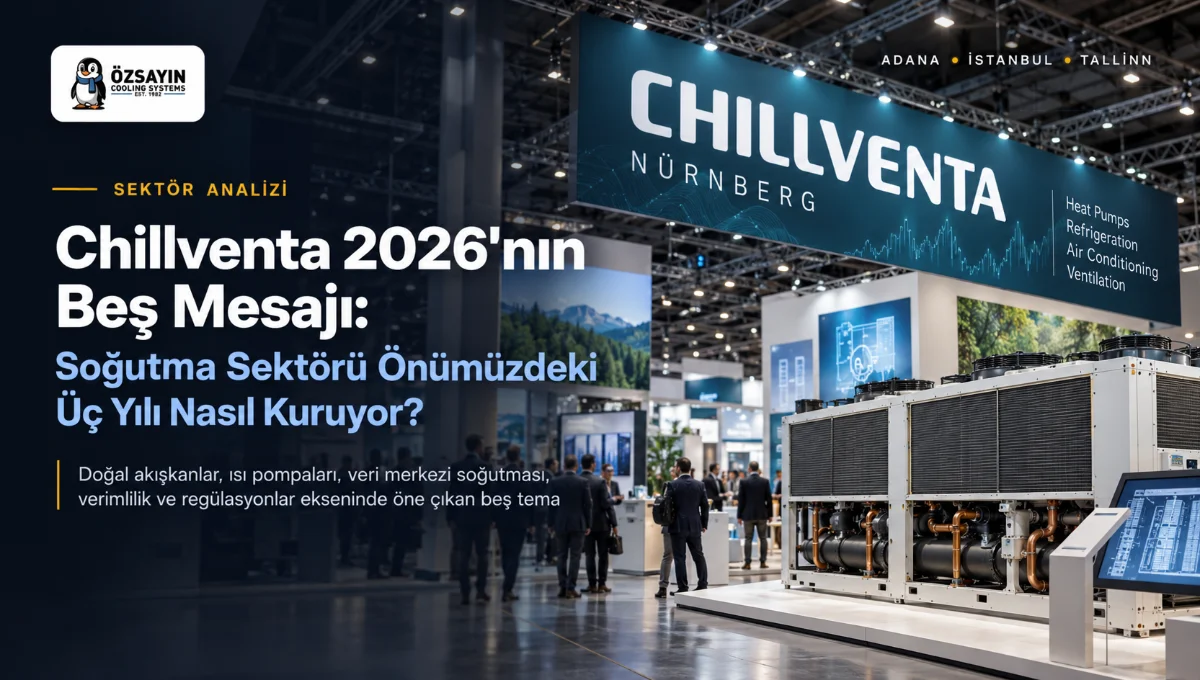
The Five Messages of Chillventa 2026: How Is the Refrigeration Industry Building the Next Three Years?
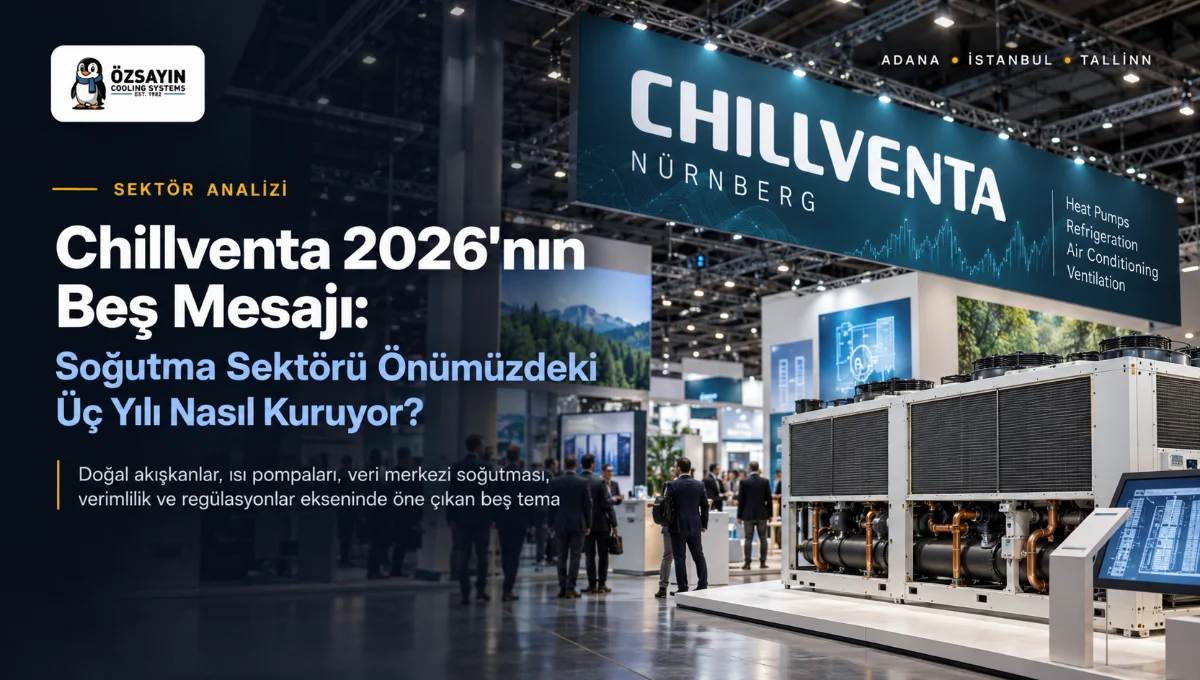
Chillventa, where the refrigeration industry gathers every two years, took place in Nuremberg on 13–15 October 2026 and closed with a record: 1,170 exhibiting companies from 50 countries (a 16% increase on 2024) and more than 36,000 visitors (a 10% increase). Around 60% of visitors came from outside Germany. More than 200 presentations were given at the parallel congress and three expert forums; the congress itself drew more than 300 participants.
Trade fair reports usually turn into a tour of the stands. In this article we do something different: we distil the topics that recurred over the three days into five messages and write down the practical meaning of each for a refrigeration business operating in Türkiye.
Message 1: Natural refrigerants are no longer an "alternative", they are the default
The centre of gravity of the show was CO2 (R744), propane (R290) and A2L-class refrigerants. A large share of the solutions on display, from commercial refrigeration to heat pumps, industrial systems and new-generation domestic products, was built around these three topics.
What has changed? Until a few shows ago, natural refrigerants sat on the shelf of "future technology"; now they are the main product line itself. This means that the F-Gas schedule has fully settled into product roadmaps.
What it means for Türkiye: For any company supplying products to the EU or buying equipment from the EU, refrigerant selection is now a commercial decision, not a technical one. The design constraints brought by propane and CO2 — flammability precautions, high-pressure components, machine room ventilation and personnel certification — are not items that can be added to the project afterwards. Our refrigerant comparison goes into these criteria in detail.
Message 2: The heat pump side has moved to high temperature
A significant share of the heat pumps on display were in the industrial and high-temperature class; new propane-based models were among the prominent product groups.
What has changed? The heat pump debate is moving from residential heating to industrial processes. The high-temperature heat pump comes with the claim of replacing the boiler.
What it means for Türkiye: This is the refrigeration engineer's business. In terms of components and cycle logic, a high-temperature heat pump is a chiller read in reverse. The same compressor technology, the same heat exchanger engineering, the same refrigerant knowledge. In food, textile, chemical and paper plants, some of the boilers producing process heat will be up for debate with this technology in the coming years. For a refrigeration company, this is an adjacent market that can be entered with existing competence.
Message 3: Data centre cooling is now a discipline of its own
Data centre cooling was among the main theme topics of the show. This indicates that the transformation AI hardware has created in mechanical installations has moved to the centre of the industry agenda.
An investment news item from the same weeks completes the picture: in October 2026, Carrier announced it would build a commercial chiller manufacturing and engineering centre of more than 1 million ft² in Fort Worth, Texas, with an investment of more than USD 600 million. The facility will come online in 2027 and employ 1,500 people. Chairman and CEO David Gitlin referred in his statement to the strong demand secured; the demand sources listed were data centres, healthcare, education and industry.
What it means for Türkiye: Global chiller manufacturing capacity is repositioning around data centre demand. This has two practical consequences. First, lead times for standard commercial chillers will be affected by this wave of demand; equipment delivery times should be locked in earlier in project schedules. Second, the commercial value of the overhaul and remanufacturing option is rising — the only way to eliminate lead-time risk is to keep existing equipment alive. We covered the architectural change on the data centre side in a separate article.
Message 4: Digitalisation has moved from the control panel to the data layer
This year the show opened a new area dedicated to digitalisation and AI (Future Hub); connected controllers and cloud services were a widespread exhibition topic.
What has changed? A few years ago, a "smart controller" was a product feature. Now the discussion is about where the data goes, how it is interpreted and which service it is turned into.
What it means for Türkiye: There is a business model opportunity here. Equipment sales are one-off revenue; monitoring and proactive service are recurring revenue. While manufacturers build this layer with their own cloud services, the real value for independent service companies lies in brand-independent monitoring and interpretation capability. If a facility has six plants from four different brands, what the customer wants is not six separate portals but a single dashboard.
Message 5: The circular economy has moved from a compliance topic to a cost topic
Sustainability and the circular economy were among the recurring themes of the show. For a long time this topic remained a section of corporate reports; it is now directly linked to procurement cost.
What it means for Türkiye: Refrigerant recovery, component refurbishment and equipment remanufacturing are turning into a cost advantage under quota pressure. The difference between overhauling a compressor and ordering a new one is today not only price but also lead time and refrigerant availability. Remanufacturing is one of the few areas where Türkiye's engineering and labour structure is globally competitive.
Visibility of Turkish companies
The presence of Turkish manufacturers at the show was notable; Form Endüstri Ürünleri and Form Freva, together with İmbat, which has been accepted into the Turquality brand programme, were among the companies present in Nuremberg. This is consistent with the rise of Türkiye's HVAC exports.
Converting trade fair visibility into commercial return requires a separate discipline: technical documentation ready in the language and standard of the target market, certification completed, and an after-sales service model that can be answered for when asked. A European buyer's first three questions are usually not price, but these three topics.
Frequently asked questions
When and where is Chillventa held?
It is held every two years at the Nuremberg Exhibition Centre. The 2026 show took place on 13–15 October. The next Chillventa will be on 10–12 October 2028; the congress on 9 October 2028. In addition, the European Heat Pump Summit is planned for 26–27 October 2027.
Is the transition to natural refrigerants also mandatory in Türkiye?
Türkiye's fluorinated greenhouse gas regulation runs differently from the EU schedule; there is no direct "natural refrigerant obligation". However, for companies supplying products to the EU or using EU-origin equipment, it is the EU schedule that is decisive in practice.
What temperatures do high-temperature heat pumps reach?
It varies by product and refrigerant; industrial-class solutions target levels that would make them an alternative to boilers at process water temperatures. The decisive factor is the difference between the target temperature and the source temperature; as this difference grows, efficiency falls. Each application needs to be evaluated against its own temperature profile.
Can trade fair data be regarded as a market indicator?
It is a trend indicator, not direct sales data. The 16% increase in exhibitor numbers and the fact that 60% of visitors were international say that the industry's appetite for investment is alive; it does not say which product group will sell how much.
Conclusion
The five topics of Chillventa 2026 can in fact be summed up in a single sentence: the refrigeration industry has turned the refrigerant transition imposed by regulation into a wave of product renewal, and has built a data layer on top of that wave.
The takeaway for a business in Türkiye is clear: refrigerant strategy, adjacent markets such as high-temperature heat pumps, monitoring services and remanufacturing capability — these four are not separate projects but parts of the same transformation.
At Özsayın Soğutma, we provide engineering support on refrigerant conversion, equipment renewal and remote monitoring. Contact us to review your facility's roadmap together.