
Recovering Chiller Condenser Heat: The Economics of Producing Hot Water from the Heat You Reject
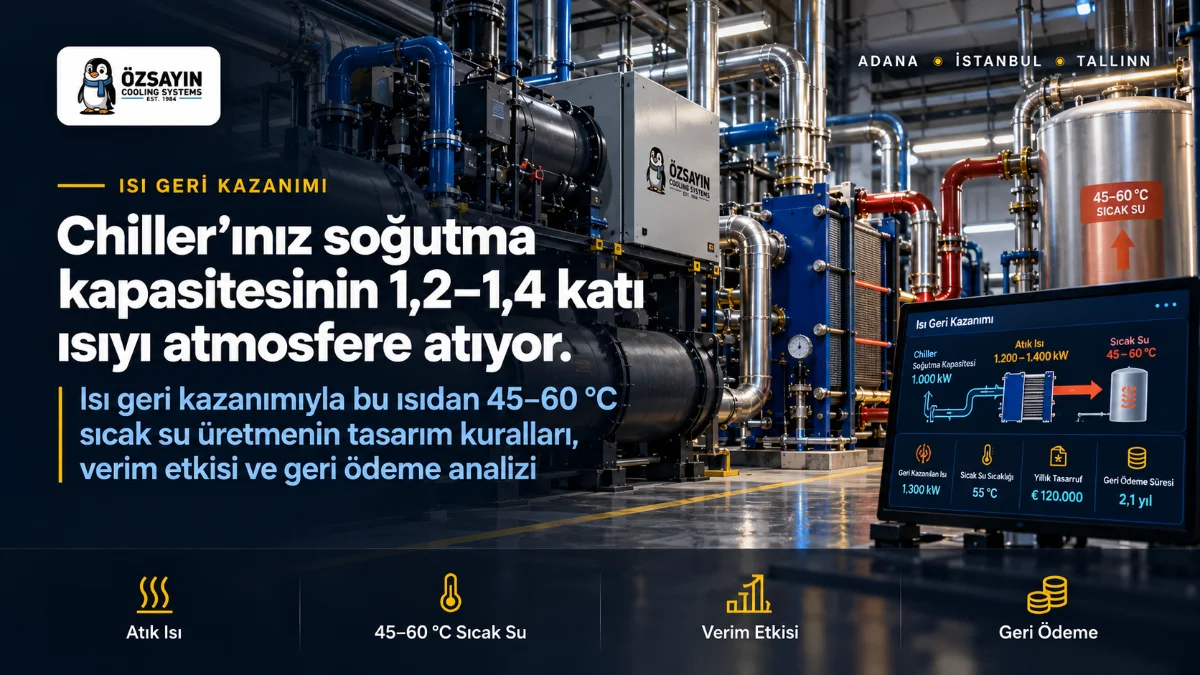
In a single facility, two things happen at the same time: the chiller rejects heat outdoors, while the boiler generates heat for the same facility. Most of the time these two processes run unaware of each other. Heat recovery is the engineering of resolving that contradiction.
The topic often appears under the heading of energy efficiency, but it is usually treated superficially. In this article we cover the part that runs from the physics to the investment decision: how much heat can be recovered, at what temperature, what it costs in cooling efficiency, and in which facilities the payback is genuinely short.
First, the scale: how much heat are you rejecting?
The heat a chiller rejects at the condenser is greater than the heat it removes. This is thermodynamically unavoidable:
Condenser heat = Cooling capacity + Compressor power input
For a plant with a COP of 5, this means heat of roughly 1.2 times the cooling capacity. Because COP falls when the condensing temperature is raised for heat recovery, the ratio rises to 1.3–1.4 times.
In concrete terms: a chiller with a cooling capacity of 1,000 kW releases 1,200–1,400 kW of heat to the atmosphere or the cooling tower while running. A plant operating 4,500 hours per year rejects roughly 5.4–6.3 GWh of heat. The boiler room of the same facility regenerates part of that heat by burning natural gas.
At what temperature can hot water be obtained?
The condensing temperature sets the limit of recovery. The values achieved in commercial products are as follows:
| Approach | Hot water outlet temperature | Typical use |
|---|---|---|
| Superheated gas (desuperheater) | Variable, limited capacity | Pre-heating, backup |
| Standard condensing heat recovery | 45–49 °C | Radiant heating, swimming pool, domestic hot water pre-heating, VAV reheat |
| Elevated condensing | 55–60 °C | Laundry, process water, domestic hot water |
The meaningful number for comparison is this: in operation with heat recovery, the effective heating COP can exceed 5.0. The efficiency of a natural gas boiler, by definition, is below 1.0. That is how large the difference in primary energy spent to produce the same heat is.
Why does the 60 °C limit matter?
Because of the Legionella risk in domestic hot water, storage is expected to be kept at 60 °C. Since heat recovery operates just below or at this threshold, the most sound arrangement in practice is pre-heating: mains water is raised from 12 °C to 50 °C using chiller heat, and the last 10 °C is completed by a boiler or electric heater. In this way most of the boiler load is eliminated, and the hygiene requirement is still met.
What is the cost: how much does cooling efficiency drop?
This is the part most often skipped in sales presentations. Raising the condensing temperature increases the pressure difference (lift) between the compressor discharge and suction. As the lift grows, the power the compressor draws per unit of cooling increases, that is, the cooling COP falls.
Heat recovery is therefore not a free gain; it is a cheap trade-off. Whether the trade-off makes sense comes down to a single comparison:
- Lost: Increased electricity consumption on the cooling side
- Gained: Fuel not burned in the boiler
The ratio of electricity to natural gas prices determines this equation and changes over time. For this reason, the feasibility study should be carried out with current energy unit prices and the facility's actual operating profile; a blanket statement of "always profitable" is not correct.
In well-designed systems, this trade-off is made only during the hours when heat is needed. The control strategy preserves cooling efficiency by returning the plant to normal condensing temperature when there is no hot water demand.
Payback: in which facilities is it genuinely short?
An example from Carrier's documentation on heat recovery chillers is instructive for showing the order of magnitude: for a plant of 100 tons (about 350 kW) capacity, assuming 4,500 operating hours per year and a gas price of $0.80/therm, annual heating cost savings compared with a boiler are over $75,000. The manufacturer states payback in many applications as one to two years.
These figures are based on US energy prices and cannot be used directly for Türkiye. But the real message lies not in the prices but in the conditions: payback is short in facilities where cooling and heating needs occur simultaneously.
Businesses with high simultaneity
- Food production: While process cooling runs continuously, CIP (clean-in-place) lines require water at 50–60 °C. In a HACCP-compliant cooling setup, this match is almost structural.
- Hotels: Air conditioning load overlaps with domestic hot water and pool heating demand throughout the summer.
- Hospitals: A year-round cooling load coexists with continuous hot water demand.
- Textiles and chemicals: Process cooling and heating of washing/dyeing water take place in the same shift.
- Laundries and central kitchens: Even though the cooling load is low, hot water demand is intense.
Cases with low simultaneity
In an office building that operates only in summer for air conditioning, with its heating need confined to winter, the value of heat recovery is limited. In such facilities, the payback period lengthens unless the investment is evaluated together with heat storage.
Implementation: can it be added to an existing chiller?
There are three routes, and their costs differ markedly.
1. Superheated gas heat recovery (desuperheater)
A heat exchanger is added to the superheated gas line at the compressor outlet. The amount of heat recovered is a small portion of the total condenser heat, but the temperature level is high. It is the easiest to add to an existing plant and the lowest-investment solution. It is suitable for pre-heating applications.
2. Parallel recovery heat exchanger
A plate heat exchanger and a three-way valve are placed in parallel with the condenser circuit, and heat is directed to the hot water circuit when there is demand. Capacity is higher and a control strategy is required. It is the most commonly applied method on existing plants.
3. Dual-condenser heat recovery chiller
This is a factory-built solution with a separate recovery condenser. It gives the highest efficiency and the widest control range, but it needs to be considered together with a decision to renew the plant. When selecting a new chiller, taking future heat demand into account eliminates the retrofit cost entirely.
Three details overlooked in design
- Fouling allowance: The recovery heat exchanger is an additional fouling surface on the condenser side. If cleaning access is not planned in the design, performance quietly declines within a few seasons.
- Hydraulic balance: In systems where flow is diverted with a three-way valve, the condenser flow rate must remain constant. If the flow drops, condensing pressure rises unexpectedly and the safety device trips.
- Heat storage: Cooling and heating demand do not match one-to-one every hour. An accumulation tank in the order of 1,000–3,000 litres noticeably raises the simultaneity ratio and shortens the payback period.
Frequently asked questions
Does heat recovery shorten the chiller's life?
Not in a correctly designed system. As long as the condensing temperature stays within the operating envelope permitted by the manufacturer, the compressor is not damaged. The risk lies in uncontrolled arrangements that go outside the envelope; for this reason, the recovery circuit must always be sized together with the plant's operating limits.
Can it also be applied to air-cooled chillers?
Yes. In air-cooled plants, superheated gas recovery or a separate recovery condenser is used. Integration is somewhat more complex than for water-cooled systems, but there is no technical obstacle.
Will my cooling capacity change?
When the condensing temperature rises, cooling capacity drops somewhat. Capacity selection should therefore be verified against the values in heat recovery mode. Doing the capacity calculation only at nominal conditions can lead to a cooling shortfall during hours of high hot water demand.
What data is needed for a feasibility study?
Four items are sufficient: the plant's hourly load profile, the hourly profile of hot water demand and the temperature requirement, the efficiency and fuel consumption of the existing boiler, and current electricity and gas unit prices. A calculation made without these four data points is no more than an estimate.
Conclusion
Heat recovery is less a matter of buying new equipment than a matter of making use of a resource the existing system already produces. In facilities where cooling and heating needs occur simultaneously, a source whose heating COP can exceed 5 sits next to a boiler operating at an efficiency below 1.
At Özsayın we provide heat recovery feasibility studies, heat exchanger and control design, and implementation services for existing plants. To map your facility's simultaneity profile and carry out the payback analysis, contact us.